

I’ve spent countless hours trying to find accurate contact information for prospects, and I know how frustrating it can be. You send cold emails to bounce-back addresses, dial disconnected numbers, and waste precious time on outdated data.
That’s where RocketRereach comes in.
I’ve been using this platform for my prospecting needs, and I wanted to share my honest experience with you. In this comprehensive RocketReach review, I’ll walk you through everything you need to know about this tool.
You’ll discover what RocketReach actually is, how accurate their data really is, and whether the pricing justifies the investment. I’ll also compare it with top alternatives like ZoomInfo so you can make an informed decision.
Whether you’re a sales professional hunting for qualified leads, a recruiter searching for top talent, or a marketer building outreach campaigns, this review will help you decide if RocketReach is right for you.
What is RocketReach?
RocketReach is a contact information database that helps me find email addresses, phone numbers, and social media profiles of professionals and companies. I use it regularly to connect with prospects I couldn’t reach otherwise.
The platform gives me access to over 700 million professional profiles across 35 million companies worldwide. That’s massive coverage for B2B prospecting.
I primarily use RocketReach for three main purposes. First, lead generation – finding decision-makers at target companies. Second, recruitment – sourcing candidates with specific skills and experience. Third, sales prospecting – building lists of qualified leads for outreach campaigns.
What I love about RocketReach is how it aggregates data from multiple sources. The platform pulls information from public profiles, social networks, company websites, and professional databases. This gives me a comprehensive view of each contact.
The tool integrates seamlessly with my existing workflow. I can export contacts directly to my CRM, use the Chrome extension while browsing LinkedIn, or access the API for bulk operations. The search filters are powerful too – I can narrow down prospects by job title, location, company size, industry, and more.
RocketReach isn’t just a simple email finder. It’s a complete contact intelligence platform that helps me build targeted lists, verify information, and reach the right people faster. The interface is clean and intuitive, which means I don’t waste time figuring out how to use it.
RocketReach Review 2026: Key Features & Performance
I’ve tested RocketReach extensively, and I want to share what actually works and what doesn’t. Let me break down the key features based on my real-world experience.
Contact Discovery Engine
The email finder is RocketReach’s strongest feature. I’ve found that the accuracy rate sits around 85-90% for verified email addresses. That’s pretty solid compared to other tools I’ve used.
The phone number database is decent but not perfect. I get better results for executives and decision-makers than for mid-level employees. About 60-70% of the numbers I’ve tried are accurate and current.
Social media profile linking works well. RocketReach connects me to LinkedIn, Twitter, Facebook, and other platforms automatically. This gives me multiple ways to reach out to prospects.
Chrome Extension
I use the Chrome extension daily while browsing LinkedIn. It’s a game-changer for my workflow. I simply click on someone’s profile, and RocketReach instantly shows me their contact details without leaving the page.
Bulk Lookup Capabilities
When I need to process large lists, the bulk lookup feature saves me hours. I can upload a CSV with names and companies, and RocketReach enriches the data with emails and phone numbers. The turnaround time is quick – usually within minutes for lists under 1,000 contacts.
CRM Integrations
RocketReach integrates with Salesforce, HubSpot, and other major CRMs. I appreciate the one-click export feature that pushes contacts directly into my pipeline.
API Access
For advanced users, the API is robust and well-documented. I’ve built custom workflows that automatically enrich leads as they enter my system.
User Interface
The dashboard is clean and easy to navigate. I didn’t need any training to get started. The search functionality is intuitive with helpful filters that let me drill down to exactly who I’m looking for.
Is RocketReach Legit?
Yes, RocketReach is a legitimate platform and one of the more established names in the contact intelligence space. I’ve been using it for a while now, and I can say with confidence that it’s not a scam or a fly-by-night service.
RocketReach has been around since 2015 and has built a reputation as a reliable data provider for sales teams, recruiters, and marketers worldwide. The company serves well-known clients across industries, which speaks to its credibility in the B2B data space.
That said, “legit” doesn’t always mean “perfect,” so let me be transparent about what you can actually expect.
On the data side, the platform delivers what it promises: real contact information pulled from publicly available sources, professional networks, and company databases. The 85-90% email accuracy I mentioned earlier is consistent with what other users report online, so there are no hidden surprises there.
From a business practices standpoint, RocketReach is transparent about its pricing, offers a free plan so you can test before committing, and provides standard data protection policies. I’ve never experienced any shady billing practices or unexpected charges on my account.
One concern some users raise is around data privacy, specifically, whether RocketReach has the right to store and sell contact information. RocketReach operates by aggregating publicly available data, which is a common and accepted practice in the B2B data industry. They also offer an opt-out option for individuals who don’t want their information in the database, which is a reassuring sign of responsible data handling.
RocketReach Pricing Plans Breakdown
I’ve analyzed the RocketReach pricing structure carefully, and I want to give you the real breakdown. Understanding the cost is crucial before you commit.
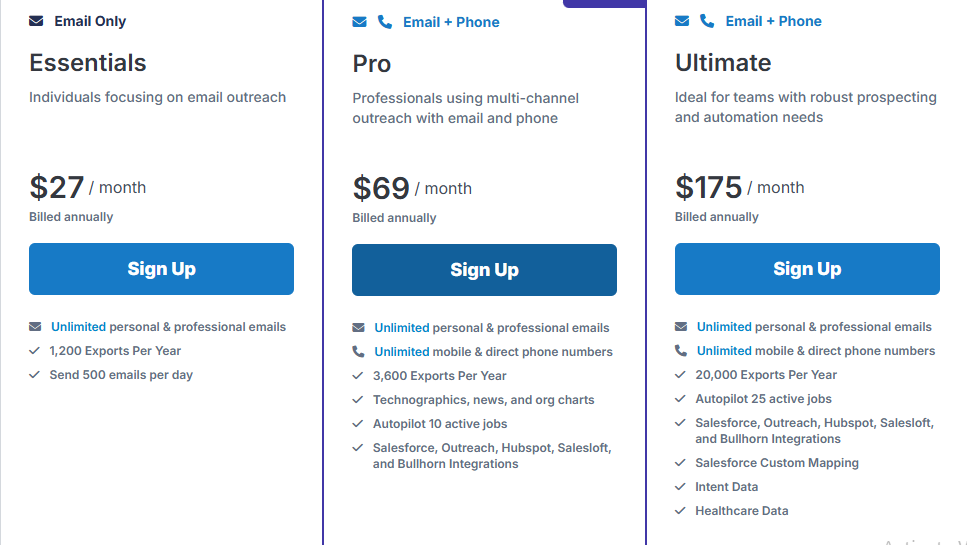
RocketReach Pricing Table (Annual Billing – Save 50%)
| Plan | Price/Month | Annual Cost | Exports Per Year | Email Access | Phone Numbers | Best For |
|---|---|---|---|---|---|---|
| Essentials | $27 | $324 | 1,200 | Unlimited personal & professional emails | Not included | Solo users focusing on email outreach |
| Pro | $69 | $828 | 3,600 | Unlimited personal & professional emails | Unlimited mobile & direct phones | Sales professionals using multi-channel outreach |
| Ultimate | $175 | $2,100 | 20,000 | Unlimited personal & professional emails | Unlimited mobile & direct phones | Teams with heavy prospecting needs |
RocketReach Free Plan Limitations
Offers a free plan that gives you 5 lookups per month. That’s extremely limited. I found it useful only for testing the platform, not for actual prospecting work. You can search and browse profiles, but you’ll hit the lookup limit fast.
Essentials Plan ($27/month)
The Essentials plan is perfect if you only need email addresses for outreach. At $27 monthly (billed annually), you get unlimited email lookups and 1,200 exports per year. That breaks down to 100 exports monthly.
I found this plan works for solo entrepreneurs or freelancers who rely primarily on email campaigns. However, you won’t get phone numbers, which limits your multi-channel outreach capabilities.
Pro Plan ($69/month) – Best Value
I currently use the Pro plan at $69 per month when billed annually. This is RocketReach’s most popular tier, and I understand why.
You get unlimited email AND phone number access, plus 3,600 exports yearly (300 per month). The plan includes technographics, news alerts, org charts, and Autopilot with 10 active jobs. CRM integrations with Salesforce, HubSpot, Outreach, Salesloft, and Bullhorn are included.
This plan suits active sales professionals and small teams who need comprehensive contact data for multi-channel prospecting.
Ultimate Plan ($175/month)
The Ultimate plan costs $175 monthly with 20,000 annual exports (about 1,667 per month). That’s serious volume for high-intensity prospecting.
You get everything from the Pro plan plus Autopilot with 25 active jobs, Salesforce custom mapping, intent data, and healthcare data. Teams and agencies doing large-scale outreach typically choose this tier.
Custom Enterprise Solutions
For larger organizations, RocketReach offers custom enterprise packages with unlimited exports and dedicated support. Pricing isn’t listed publicly – you need to contact their sales team.
Value for Money Analysis
Here’s my honest take: The 50% discount on annual plans makes a huge difference. Monthly billing doubles your cost, so annual commitment is worth it if you plan to use RocketReach regularly.
The Pro plan offers the best value for most users. You get both emails and phone numbers, which is essential for effective outreach. The price point of $69 monthly is reasonable compared to competitors.
Credit System Explanation
RocketReach moved away from the old credit system to an export-based model. Now you get unlimited lookups but limited exports based on your plan tier. One export equals one contact’s information (email, phone, social profiles).
Exports reset annually, not monthly, which gives you more flexibility. However, they don’t roll over, so unused exports expire at your renewal date. I manage my exports carefully to avoid waste, especially on the lower-tier plans.
RocketReach vs ZoomInfo: Head-to-Head Comparison
I’ve used both platforms extensively, and people always ask me which one is better. Here’s my honest comparison based on real experience.
| Feature | RocketReach | ZoomInfo |
|---|---|---|
| Database Size | 700M+ profiles, 35M companies | 135M+ profiles, 14M companies |
| Starting Price | $39/month (170 credits) | $15,000+/year (enterprise only) |
| Email Accuracy | 85-90% | 90-95% |
| Phone Numbers | 60-70% accuracy | 75-85% accuracy |
| Best For | SMBs, startups, freelancers | Enterprise sales teams |
| Ease of Use | Simple, intuitive interface | Steeper learning curve |
| Contract Terms | Monthly or annual plans | Annual contracts required |
Database Size Comparison
RocketReach wins on sheer volume with over 700 million profiles. However, ZoomInfo focuses on quality over quantity with more verified B2B contacts. I find RocketReach better for broad searches, while ZoomInfo excels at enterprise-level contacts.
Pricing Differences
This is where the gap widens dramatically. RocketReach starts at $39 monthly, making it accessible for small businesses. ZoomInfo requires a minimum $15,000 annual commitment, which puts it out of reach for most solo professionals and startups.
Accuracy Rates
ZoomInfo edges out RocketReach slightly on accuracy. I’ve experienced about 5-10% higher verification rates with ZoomInfo emails. Phone numbers are also more current. But RocketReach’s 85-90% email accuracy is still solid for most use cases.
Best Use Cases
I recommend RocketReach for small to mid-sized businesses, startups, recruiters, and independent sales professionals. The flexible pricing and easy setup make it perfect for teams of under 50 people.
ZoomInfo makes sense for large enterprises with dedicated sales teams, complex sales cycles, and bigger budgets. The advanced features justify the cost when you’re closing six-figure deals.
If you want a deeper breakdown of features, pricing structures, contract terms, and real-world data accuracy differences, I’ve created a detailed RocketReach vs ZoomInfo comparison guide that walks through everything step-by-step.
Which Tool Wins for Different Business Sizes?
For solopreneurs and startups (1-10 employees), RocketReach is the clear winner. You get great value without breaking the bank.
For growing companies (10-50 employees), RocketReach still wins unless you have enterprise clients and need the highest accuracy possible.
For enterprises (50+ employees), ZoomInfo becomes worth considering if budget allows. The ROI justifies the investment when you’re running large-scale outreach campaigns.
Top RocketReach Alternatives & Competitors
I’ve tested numerous RocketReach alternatives over the years, and I want to share the best options I’ve found. Each tool has unique strengths depending on your specific needs.
Apollo.io – The All-in-One Solution
Apollo.io is my top RocketReach alternative and the platform I recommend most for modern sales teams. I’ve written a full apollo io review where I break down its lead database, email automation, pricing, and real-world performance.
The database includes over 275 million contacts and 73 million companies. I love that Apollo offers a generous free plan with 50 email credits monthly. Paid plans start at $49 per user per month.
Pros: Built-in email automation, unlimited email finder on higher plans, excellent Chrome extension, strong LinkedIn integration.
Cons: Phone number accuracy could be better, the interface feels cluttered at times, credit system can be confusing for new users.
Hunter.io – Email Finding Specialist
Hunter.io focuses purely on email finding, and it does this exceptionally well. I use it when I only need email addresses without phone numbers or other data.
The free plan gives you 25 searches monthly. Paid plans start at $34 per month for 500 searches. Hunter verifies emails before showing them, which reduces bounce rates significantly.
I appreciate the domain search feature that finds all email addresses associated with a company. The email verifier tool is accurate and helps me clean existing lists.
Lusha – Chrome Extension Powerhouse
Lusha excels as a Chrome extension alternative to RocketReach. I find it slightly faster when browsing LinkedIn profiles.
The free plan offers 5 credits monthly. Paid plans start at $29 per user per month. Lusha specializes in direct dial phone numbers, which I find more accurate than RocketReach for cold calling.
The interface is cleaner and simpler. However, the database is smaller, so I sometimes miss contacts that RocketReach would find.
Cognism – European Market Leader
Cognism dominates the European market with GDPR-compliant data. I recommend it for companies targeting EU prospects.
Pricing isn’t publicly available – you need to request a quote. From my experience, it’s positioned between RocketReach and ZoomInfo in cost.
The phone-verified mobile numbers are Cognism’s killer feature. I get better connection rates with European contacts compared to other tools.
Seamless.AI – Real-Time Data Provider
Seamless.AI claims to provide real-time verified data, which sounds impressive. I’ve tested it and found the data freshness is indeed better than static databases.
The free plan is surprisingly generous with unlimited searches (but limited reveals). Paid plans start around $125 per month.
The real-time verification means higher accuracy, but searches take longer. I use Seamless.AI when I absolutely need current information for high-value prospects.
LinkedIn Sales Navigator – The Native Solution
LinkedIn Sales Navigator isn’t a direct RocketReach competitor, but it’s worth mentioning. It costs $99 per month and gives you an advanced LinkedIn search with InMail credits.
I combine Sales Navigator with RocketReach for the best results. Sales Navigator helps me find the right people, then RocketReach gives me their contact details.
Comparison Table: RocketReach Alternatives
| Tool | Starting Price | Database Size | Best For | Free Plan |
|---|---|---|---|---|
| Apollo.io | $49/month | 275M contacts | All-in-one prospecting | 50 credits/month |
| Hunter.io | $34/month | 100M+ emails | Email finding only | 25 searches/month |
| Lusha | $29/month | 45M+ contacts | Chrome extension users | 5 credits/month |
| Cognism | Custom pricing | 400M+ profiles | European markets | Demo only |
| Seamless.AI | $125/month | Real-time data | High-value prospects | Unlimited searches |
| LinkedIn Sales Navigator | $99/month | LinkedIn network | Social selling | No |
Pros and Cons of RocketReach
Based on my extensive experience with RocketReach, here’s my honest assessment of what works and what doesn’t.
Advantages:
- Extensive database: Access to over 700 million profiles gives me broad coverage across industries and geographies. I rarely search for someone and come up empty.
- User-friendly interface: I got started immediately without training. The dashboard is intuitive, search filters make sense, and the Chrome extension works seamlessly.
- Multiple integration options: Direct connections with Salesforce, HubSpot, and other CRMs save me time. I can push contacts into my workflow with one click.
- Flexible pricing tiers: Unlike ZoomInfo, I’m not locked into massive annual contracts. I can scale up or down based on my needs.
- Chrome extension convenience: Finding contact details while browsing LinkedIn has become second nature. It fits naturally into my prospecting workflow.
- Bulk lookup feature: Processing large lists saves me hours compared to manual research. The turnaround time is impressively fast.
Disadvantages:
- Credit-based system limitations: Credits expire monthly without rollover, which feels wasteful. I’ve lost unused credits several times when my prospecting slowed down.
- Pricing transparency issues: The credit system isn’t always clear upfront. Understanding what counts as a lookup took me some time to figure out.
- Data accuracy variations: While 85-90% email accuracy is decent, it’s not perfect. I still experience bounces, especially with phone numbers where accuracy drops to 60-70%.
- No unlimited plans: Even the highest tiers cap your lookups. High-volume users might find this restrictive compared to alternatives like Apollo.io.
- Limited data enrichment: RocketReach focuses mainly on contact details. I wish it included more firmographic data and intent signals like some competitors offer.
Conclusion
After using RocketReach extensively, I believe it’s a solid choice for most sales professionals, recruiters, and marketers who need reliable contact data without enterprise-level budgets.
The platform’s biggest strengths are its massive database, intuitive interface, and flexible pricing. I can find contacts quickly, integrate them into my workflow seamlessly, and scale my usage as needed. The Chrome extension has become an essential part of my daily prospecting routine.
However, RocketReach isn’t perfect. The credit-based system feels restrictive at times, data accuracy could be better (especially for phone numbers), and the pricing structure takes some getting used to.
Who should use RocketReach?
I recommend RocketReach for small to mid-sized businesses, independent sales professionals, recruiters, and growing startups. If you’re doing moderate-volume prospecting and need good-quality data without spending $15,000+ annually, RocketReach hits the sweet spot.
Try Free RocketReach
Best alternatives based on your use case:
If you need an all-in-one solution with email automation, go with Apollo.io. If you only need email addresses, Hunter.io offers better value. For European prospects, Cognism is your best bet. Enterprise teams with bigger budgets should consider ZoomInfo for maximum accuracy.
Ready to get started?
I suggest starting with RocketReach’s free plan to test the platform with 5 lookups. See if the data quality meets your standards and if the interface fits your workflow. If you like what you see, the Essential plan at $39 monthly gives you enough credits to evaluate it properly.
Don’t settle for outdated contact information. Try RocketReach today or explore the alternatives I’ve covered to find the perfect fit for your prospecting needs.
Try RocketReach’s free
FAQ
What is call limit reached in Rocket League?
This refers to the video game Rocket League, not the RocketReach platform. In Rocket League, “call limit reached” is an error message that appears when too many players try to connect to game servers simultaneously. It has nothing to do with RocketReach’s contact lookup limits.
How to remove RocketReach from my computer?
To remove the RocketReach Chrome extension: Click the three dots in Chrome, go to “Extensions,” find RocketReach, and click “Remove.” To uninstall the desktop app (if installed): On Windows, go to Control Panel > Programs > Uninstall a Program, select RocketReach, and click Uninstall. On Mac, drag the RocketReach app from Applications folder to Trash, then empty Trash. Also, log into your RocketReach account and cancel your subscription if you have a paid plan to avoid future charges.
How long does it take a rocket to reach space?
This question is about space rockets, not RocketReach software. A typical rocket takes about 8-9 minutes to reach space (defined as 100km altitude). The actual time varies based on the rocket type and mission profile. This has no connection to the RocketReach contact database platform.