


I’ve been researching Apollo.io pricing for weeks, and honestly, the credit system confused me at first. You see a low starting price and think it’s affordable. Then reality hits when you start using the platform daily.
Here’s the truth: Apollo’s pricing isn’t as simple as the numbers on their website. The base price is just the beginning. What really matters is how many credits you’ll burn through each month.
Before diving into the pricing breakdown, you may also want to read my full Apollo.io review where I cover its database quality, features, and real-world accuracy.
In this guide, I’ll break down exactly how Apollo.io pricing works in 2026. No fluff, no sales talk—just the real costs you need to know before you commit. I’ll show you the actual plans, explain the credit trap, and reveal hidden costs that could double your monthly bill.
Let’s get straight to the numbers.
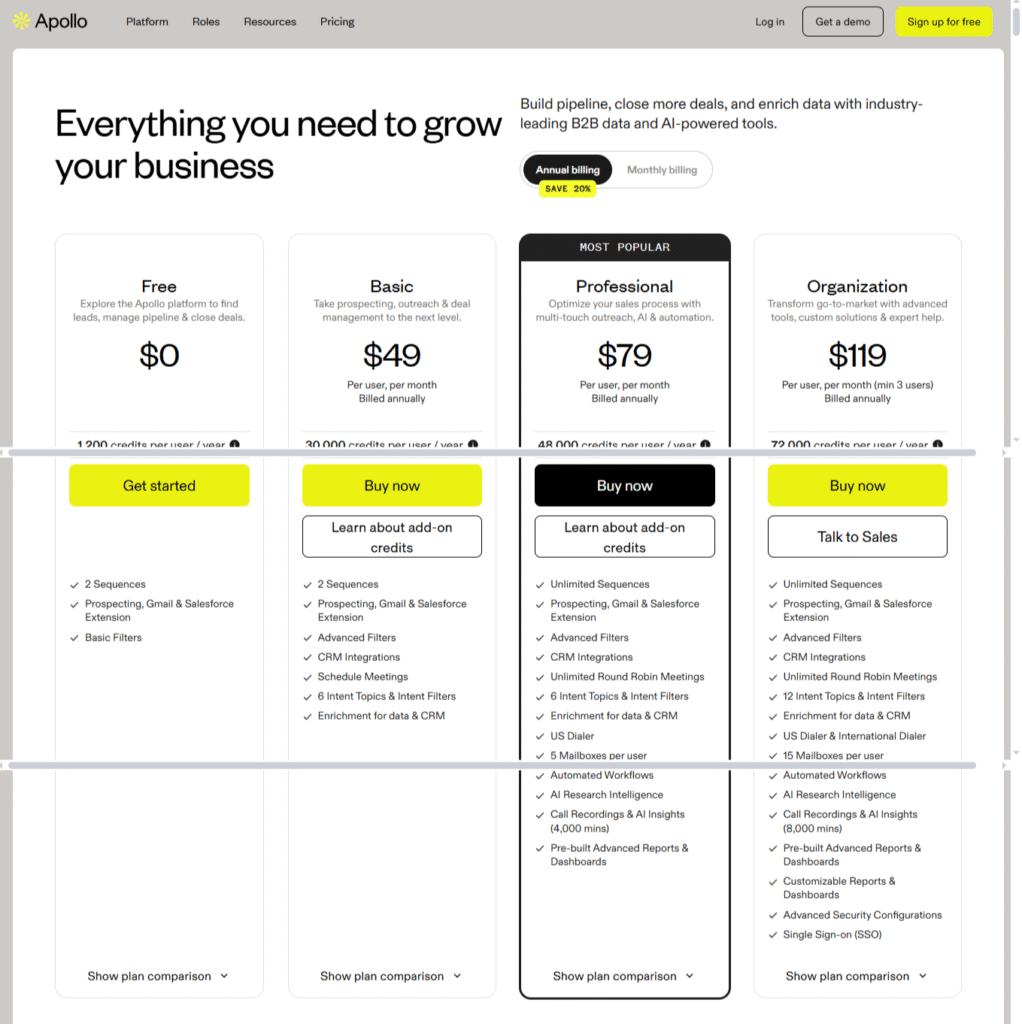
Apollo.io Pricing Overview 2026
Apollo offers four pricing tiers. Each one comes with different credit limits and features. Here’s what you’ll pay:
| Plan | Monthly Billing | Annual Billing | Best For |
|---|---|---|---|
| Free | $0 | $0 | Testing the platform |
| Basic | $59/user | $49/user | Small teams starting outbound |
| Professional | $99/user | $79/user | Growing sales teams |
| Organization | $149/user | $119/user | Enterprise teams (min. 3 seats) |
Annual vs Monthly Pricing Difference:
Going annual saves you about 20% across all plans. For example, the Professional plan drops from $99 to $79 per user monthly. That’s $240 saved per user each year.
But here’s the catch: you pay upfront for the entire year. If your team size changes or you don’t use all your credits, you’re still locked in.
Understanding Apollo’s Credit System
Apollo runs on a credit-based system. Every action you take consumes credits from your monthly allowance. This is where things get tricky.
How Credits Work:
When you search for contacts, reveal phone numbers, or export data, you use credits. Email addresses cost credits. Mobile numbers cost more credits. Even exporting contacts to your CRM drains your quota.
Credit Consumption Rates:
The Basic plan gives you 12,000 credits per year (1,000 monthly). Professional bumps it to 48,000 annually (4,000 monthly). The organization offers 72,000 credits yearly (6,000 monthly).
Here’s what burns through credits fast: revealing mobile phone numbers (typically 10 credits each), exporting large contact lists, and enriching incomplete data.
What Happens When You Run Out:
Once your credits hit zero, you’re stuck. You can’t reveal new contacts or export data until you buy more. Additional credits cost extra—usually starting at $25 for 1,000 credits on annual plans.
Monthly Rollover Policy:
This is important: Apollo credits don’t roll over. Use them or lose them. If you don’t consume your 4,000 credits this month, they vanish when your next billing cycle starts. No exceptions.
Hidden Costs & Real Total Cost of Ownership
The sticker price looks reasonable. But the real cost? That’s a different story.
Additional Credit Purchases:
Most teams run out of their monthly credits. When that happens, you need to buy more. Apollo charges $25 per 1,000 additional credits on annual plans. If your team needs 2,000 extra credits monthly, that’s $50 added to your bill each month.
Overage Fees:
While Apollo doesn’t technically charge “overage fees,” you’ll hit a wall when credits run out. Your prospecting stops until you purchase more. This creates unpredictable monthly costs that can spike unexpectedly.
Integration Costs:
Want to connect Apollo with your CRM or sales tools? Basic integrations are included, but advanced API access is only available on the Organization plan. If you’re on Basic or Professional, you might need workarounds or additional tools.
Training and Onboarding Time:
Apollo has a learning curve. Most teams spend 2-3 weeks getting comfortable with the platform. That’s time your sales reps aren’t closing deals. Factor in the productivity loss during this period.
Scalability Cost Increases:
Here’s where it hurts: Apollo charges per user. Add five new sales reps? Your monthly bill jumps by $395 (at $79/user). As your team grows, costs scale linearly—and fast.
What’s Included in Each Plan (Feature Comparison)
Each Apollo plan unlocks different features. Understanding what you get at each tier helps you avoid paying for more than you need.
Free Plan:
- Access to 275M+ contact database
- 1,200 credits annually (100/month)
- 2 active sequences
- 250 emails per day
- Chrome extension
- Basic filters only
- Limited mobile number access
Basic Plan ($49-59/user/month):
- 30,000 credits per year
- Unlimited sequences
- Advanced filters (technographic, job postings, funding data)
- CRM integrations (Salesforce, HubSpot)
- Email tracking (open and click rates)
- Meeting scheduler
- More API calls
Professional Plan ($79-99/user/month):
- 48,000 credits annually
- Everything in Basic, plus:
- A/B testing for email sequences
- Advanced automation workflows
- US-based dialer with call recording
- Custom reports and dashboards
- Intent data and buying signals
- Enhanced analytics
Organization Plan ($119-149/user/month):
- 72,000 credits per year
- Minimum 3 seats required
- Everything in Professional, plus:
- International dialer
- Single Sign-On (SSO)
- Advanced security configurations
- Priority support
- Unlimited custom reports
- API access for advanced integrations
| Feature | Free | Basic | Professional | Organization |
|---|---|---|---|---|
| Annual Credits | 1,200 | 30,000 | 48,000 | 72,000 |
| Sequences | 2 | Unlimited | Unlimited | Unlimited |
| Dialer | ✗ | ✗ | ✓ (US only) | ✓ (International) |
| A/B Testing | ✗ | ✗ | ✓ | ✓ |
| Custom Reports | ✗ | Limited | ✓ | Unlimited |
| SSO | ✗ | ✗ | ✗ | ✓ |
The jump from Basic to Professional gives you automation and analytics. The Organization plan is worth it only if you need enterprise security and international calling.
Apollo Pricing vs Competitors
Apollo vs Instantly:
Instantly starts at $37 monthly for its Growth plan, which includes unlimited email accounts and 5,000 emails per month. That’s $22 cheaper than Apollo’s Basic plan. However, Instantly focuses purely on email outreach without Apollo’s contact database. If you need lead discovery plus email automation, Apollo offers better value. But if you already have your contact lists, Instantly saves money.
If you’re confused between these two platforms, I’ve also published a detailed comparison on Apollo vs Instantly that breaks down pricing, personalization, and deliverability. you can also read my full Instantly AI review.
Apollo vs Lemlist:
Lemlist’s Email Pro plan costs $69 per user monthly, sitting between Apollo’s Basic and Professional tiers. Lemlist excels at email personalization with dynamic images and landing pages. Apollo wins on database size and multichannel features. Choose Lemlist for creative email campaigns, Apollo for comprehensive B2B prospecting.
I’ve compared both in my detailed Lemlist review and Lemlist vs Apollo guide.
Pricing Comparison Table
| Platform | Starting Price | Database Access | Email Automation | Mobile Numbers | Best For |
|---|---|---|---|---|---|
| Apollo | $49/user/month | 275M+ contacts | ✓ | ✓ (credit-based) | All-in-one B2B prospecting |
| Instantly | $37/month | ✗ | ✓ | ✗ | Email-only campaigns |
| Lemlist | $69/user/month | 600M+ contacts | ✓ | ✓ (credit-based) | Creative personalization |
Is Apollo Worth the Cost?
I’ve used Apollo for six months, and here’s my honest take on whether it delivers value for money.
Pros:
- Massive contact database – Access to 275M+ verified B2B contacts saves hours of prospecting
- Free plan available – You can test the platform risk-free before spending money
- Multi-channel outreach – Email, phone, and social media campaigns in one platform
- Built-in email sequences – Automation tools rival standalone email platforms
- CRM integrations – Connects smoothly with Salesforce and HubSpot
Cons:
- Credit system creates confusion – Tracking monthly credit usage adds mental overhead
- No website visitor identification – Can’t see who’s browsing your site (unlike competitors)
- Costs scale quickly – Adding team members gets expensive fast
- Limited real-time engagement – Lacks live chat or instant prospect identification
- Credits don’t roll over – Unused monthly credits disappear forever
The Bottom Line:
Apollo delivers solid value if you’re a mid-size team with consistent prospecting needs. The database alone justifies the cost for companies doing high-volume outbound.
But the credit system creates unpredictable expenses. You’ll likely spend more than the base price once you factor in additional credits and scaling costs.
Who Should Use Apollo?
Apollo isn’t for everyone. After testing it across different use cases, here’s who benefits most.
Best For:
Mid-size B2B sales teams (5-20 reps) with predictable monthly prospecting volumes. If you contact 200-500 new leads monthly, Apollo’s credit allocations work smoothly. The Professional plan gives you enough runway without constant top-ups.
Companies consolidating their sales stack. If you’re using separate tools for lead discovery, email automation, and dialing, Apollo replaces them all. The cost savings from dropping 2-3 subscriptions often covers Apollo’s price.
Teams needing verified contact data. Apollo’s database accuracy beats scraping LinkedIn manually. The time saved finding decision-makers makes the investment worthwhile.
Not Ideal For:
High-volume prospecting agencies that burn through thousands of leads weekly. You’ll exhaust credits fast and face constant additional purchases. The per-credit cost adds up when you’re operating at scale.
Companies focused on website visitor conversion. Apollo doesn’t identify anonymous website traffic. If your strategy relies on capturing intent signals from site visitors, you need a different tool.
Solo founders on tight budgets. The Free plan is too limited for real prospecting. Once you upgrade, you’re paying $49+ monthly even if you only prospect part-time.
Startups still validating their ICP. If you’re experimenting with different target audiences, Apollo’s credit consumption during research phase wastes money. Wait until your ideal customer profile is clear.
Better Alternatives to Consider
If Apollo’s pricing doesn’t fit your budget or workflow, here are two strong alternatives worth exploring.
1. Instantly ($37/month)
Instantly’s Growth plan starts at $37 monthly with unlimited email accounts and 5,000 emails. It’s perfect for teams that already have lead lists and just need powerful email automation.
Unique Value Proposition:
- Unlimited email warmup included
- No credit system – pay one flat rate
- Built-in deliverability monitoring
- Email validation before sending
Best for: Email-first teams, agencies managing multiple clients, budget-conscious startups.
What’s Missing: No built-in contact database. You’ll need to source leads elsewhere.
2. Lemlist ($69/month)
Lemlist’s Email Pro plan costs $69 per user monthly and focuses on email-only outreach. It shines with creative personalization features that make your emails stand out.
Unique Value Proposition:
- Dynamic image personalization (add prospect names to images)
- Custom landing pages for each recipient
- Built-in email warmup (Lemwarm)
- Access to 600M+ contact database with advanced filters
Best for: Sales teams prioritizing reply rates, creative marketers, and companies running ABM campaigns.
What’s Missing: No inbox placement testing, and scaling gets expensive with multiple workspaces.
Try Lemlist 14-Day Free Trial →
Final Verdict & Next Steps
After breaking down every aspect of Apollo’s pricing, here’s what you need to know.
Apollo offers strong value if you need an all-in-one B2B prospecting platform. The database is comprehensive, the multi-channel features work well, and the integrations are solid.
But the credit-based pricing creates frustration. You’ll spend time tracking usage, buying add-ons, and watching credits expire. For teams operating at high volume, costs spiral quickly.
My Recommendation:
Start with Apollo’s Free plan to test the database quality. Run 50-100 searches to see if the contacts match your ICP. If the data looks good and you’re confident about monthly volume, upgrade to Professional for the best feature-to-cost ratio.
If the credit system feels too restrictive, try Instantly for pure email automation or Lemlist for creative personalization. Both offer more predictable pricing.
Ready to Get Started?
Choose the option that fits your team:
👉 Start Apollo Free Trial – Test the full platform risk-free
👉 Compare All Alternatives – Explore other options before committing
The best sales tool is the one your team actually uses. Pick what matches your workflow, not just your budget.
FAQs
Does Apollo have a free plan?
Yes, Apollo offers a free forever plan with 1,200 credits annually (100 per month). You get access to the contact database, 2 active sequences, and basic filters. It’s enough for testing but too limited for daily prospecting.
How much does Apollo cost per user?
Apollo pricing ranges from $49-$149 per user monthly depending on the plan. Basic starts at $49, Professional at $79, and Organization at $119 (minimum 3 seats). Annual billing saves about 20%.
What are Apollo credits?
Credits are Apollo’s consumption currency. Every time you reveal contact information, export data, or access mobile numbers, you use credits. Different actions consume different amounts. Mobile numbers typically cost more credits than email addresses.
Can I get a discount on Apollo?
Apollo offers approximately 20% discount when you pay annually instead of monthly. They occasionally run promotions for new customers. Enterprise teams negotiating multiple seats may receive custom pricing.
Does Apollo io pricing include CRM integration?
Yes, basic CRM integrations with Salesforce and HubSpot are included starting from the Basic plan. Advanced API access for custom integrations requires the Organization plan at $119+ per user monthly.